
News
Nookdeck turns an old iPhone into a customizable Stream Deck-style desk controller
Open-source desktop software repurposes old phones and tablets into touch control panels, including devices running iOS 12.
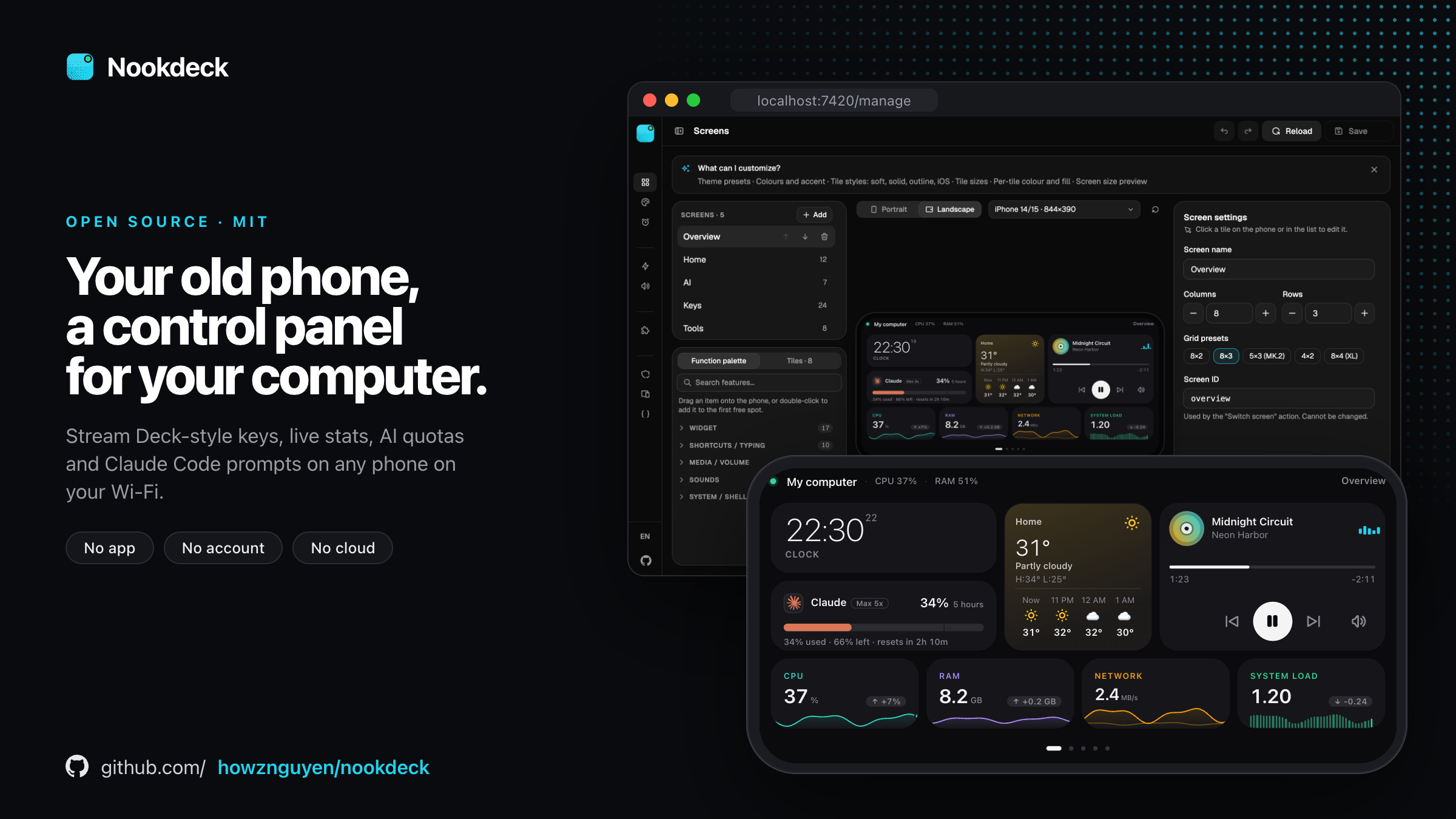
A perfectly usable phone sitting in a drawer may be one of the cheapest ways to add a dedicated control surface to a desk. Nookdeck, an early-stage open-source project featured on Product Hunt on November 26, repurposes a phone or tablet as a touch controller for a computer. The developer's own project page was published November 22.
The old phone does not need another app
A companion program runs on the computer and serves the interface to a mobile browser over the same Wi-Fi network. The developer says Safari on iOS 12 is supported, bringing the iPhone 5s, iPhone 6 and other otherwise retired devices into the equation. The phone connects using a pairing PIN and does not require a separate mobile app or account.
A paired phone can display a grid of app shortcuts, music controls, clock and weather tiles, system statistics and other widgets. The browser interface can be arranged to show the controls that matter to the user rather than a fixed layout. This makes the idea useful for someone who wants a desk-side music controller or shortcuts without fitting another full-screen monitor onto a crowded workspace. Optional integrations can also bring together compatible Home Assistant controls and OBS shortcuts.
A useful idea, with early-stage limitations
Nookdeck is free and MIT licensed. Its main platform is macOS 13 or later, with Windows and Linux support described as experimental. The developer notes that builds are not currently notarized or signed, an important consideration before trusting software able to control a computer. Users should not bypass normal operating-system security protections.
This is still an early project rather than a replacement for a supported commercial macro pad, but the reuse angle is compelling: the touch display and battery are already in your drawer. More information is available on the developer's project page and the source repository.


Letters to the editor
0 commentsNo comments yet. Be the first to write in.